Doctor Dan the Bandage Man

Many people remember Little Golden Books from their childhoods. They’re small, filled with lots of colorful illustrations, and have short, heartwarming stories for young children.  Everybody probably had a favorite Little Golden Book when they were little: The Three Little Kittens, The Fuzzy Duckling, Scuffy the Tugboat, Little Red Riding Hood, The Saggy Baggy Elephant…and the one about BAND-AID® Brand Adhesive Bandages.  Wait a second…the one about WHAT?

Cover of Doctor Dan the Bandage Man, 1950

Cover of Doctor Dan the Bandage Man, courtesy of Little Golden Books

You read correctly: the one about BAND-AID® Brand Adhesive Bandages. In 1950, the publishers of Little Golden Books published Doctor Dan The Bandage Man, about a little boy named Dan who is out playing with his friends and scratches his finger.

Doctor Dan the Bandage Man -- Dan gets an adhesive bandage from his Mom

In a scene familiar to most households, Dan gets his finger bandaged by his Mom.  Illustration and Text From Doctor Dan the Bandage Man, by Helen Gaspard, courtesy of Little Golden Books

Dan runs crying to see his mom, who promptly washes the scratch and covers it with a BAND-AID® Brand Adhesive Bandage. For the rest of the book, every time a friend, a pet, a toy or his Dad gets a cut or scrape, Dan puts a bandage on the injury to make it better. On the last page, his Dad nicknames him “Doctor Dan the Bandage Man.”

 Doctor Dan the Bandage Man -- shows where BAND-AID Brand Adhesive Bandages were attached

Page showing where the six BAND-AID® Brand Adhesive Bandages were attached.

But that’s not all.  The book came with six real BAND-AID® Brand Adhesive Bandages — attached inside and advertised on the cover — so that kids could bandage their own hurt toys, should the need arise.

So how did the Company manage to get one of its most familiar products placed into a book series read by millions of parents to their children?  According to the Publisher’s Note at the beginning of the book, we didn’t…they came to us.  Here’s what Simon and Schuster (the publisher in 1950)  said:

“For a long, long time, the publishers have been ardent admirers of BAND-AID Adhesive Bandages – not only for themselves (publishers seem to cut themselves more than other people) but because of their effect on children.  We’ve noted that BAND-AID Adhesive Bandages not only cheer and comfort small boys and girls who bang themselves up, but that they make wonderful playthings as well.  No one quite knows how many millions of dolls and stuffed toys…have been patched up in this manner.”

“Consequently, when the idea for this book came to us, we promptly went to Johnson & Johnson and asked them if they would be willing to help us. They were very nice about it and asked that we point out that BAND-AID is Johnson & Johnson’s trademark for its brand of adhesive bandages and for several other products in its line.”

Besides illustrating the fact that we had a trademark law department that never slept even back in 1950, this publishers note shows that, three decades after they were invented, BAND-AID® Brand Adhesive Bandages had become such a part of parents’ and children’s lives that the most popular children’s book publisher wrote a story about them.

According to Random House (the publisher of Little Golden Books today), Doctor Dan marked one of the first ventures into book and product joint packaging, something that’s common today. And Doctor Dan’s first printing of 1.75 million copies (each copy containing six BAND-AID® Brand Adhesive Bandages – that’s a staggering 10.5 million total adhesive bandages given to readers!) is the largest first printing of any Little Golden Book to date, according to Random House’s timeline (which is dated 2002).

Here’s a good history of Little Golden Books – they were the first inexpensive, high-quality children’s books that were widely available, and allowed many more families to afford and own books for their children.

Doctor Dan the Bandage Man -- Dan bandages his sister's doll

Doctor Dan bandages his sister’s doll, courtesy of Little Golden Books

Doctor Dan the Bandage Man proved to be so popular that it was reprinted in 2004 and is still in print today (and yes, it still comes with BAND-AID® Brand Adhesive Bandages). It’s also featured in the permanent collection of the Smithsonian as a piece of American culture.

If you’re interested in reading Doctor Dan the Bandage Man, it’s available to read here.

This post was written by Margaret

Published in: Iconic Products, Advertising, Did You Know? | on July 22nd, 2008 | No Comments »

Robert Wood Johnson — Blogger?

Robert Wood Johnson

General Robert Wood Johnson – a blogger? Of course, he wasn’t — because Johnson (1893 – 1968) was from an era long before the internet and blogs. But…there’s some interesting evidence that if he were around today, he might perhaps be blogging. And what could that evidence possibly be? It was that he wanted his communications with Johnson & Johnson employees around the world to be two-way conversations and he tried to figure out a way to do that, but felt limited by the constraints of the technology that was available in the 1940s.

Cover of Robert Johnson Talks It Over

Cover of Robert Johnson Talks it Over

In 1949, Johnson published a book called Robert Johnson Talks it Over, which was a compilation of radio talks he had recorded for employees worldwide. These talks were played over the broadcasting systems in the Company’s plants and offices. Each talk explained in great detail a different aspect of Johnson & Johnson, since Johnson felt that every single employee, no matter what he or she did, should thoroughly understand every part of the business in order to fully contribute to it. According to Johnson, the recorded talks were meant to replace the informal conversations he used to have when the Company was much smaller and he knew everyone who worked there. He wrote:

“Years have passed since I knew everyone in our organization. There once was a time, however, when I did know – at least, I recognized – every man and woman who worked with Johnson & Johnson. Those men and women knew me, too, and we’d get together once in a while to talk about the Company, its progress, and its problems. In those talks I learned how others felt, and they learned what was on my mind. Anyone might ask questions, and could get answers telling just what he wanted to know.”

“We have grown too large for such discussions; if we tried to hold them now, we’d have meetings with speakers and a lot of formality, but few real results.” [Robert Johnson Talks it Over, page 1]

Here’s the interesting part. (Besides the fact that he wasn’t a fan of big, formal meetings.) Robert Wood Johnson mentioned all of the things the Company was doing to communicate to employees – internal newspapers and magazines, special booklets, the Suggestion System, and more. But he wrote that they were too formal and one-way, and he was looking for something that would come close to those two-way person-to-person talks he used to have…which is why he came up with the idea for the broadcasts. Johnson lamented the fact that the technology of the time limited these talks to one-way broadcasts, when he would have preferred them to be conversations.

“The broadcasts, of course, will have one disadvantage: I shall do most of the talking, while you will have no chance to throw in comments, questions or requests for explanations.” [Robert Johnson Talks it Over, p. 2]

So Johnson did what he could to make these broadcasts more like conversations. Their tone was informal. And in the first chapter of Robert Johnson Talks it Over, he listed ways in which these one-way talks could be made more two-way, or at least answer some of the questions from employees that would come up. Since the talks were being published, Johnson included additional information that would answer some of the questions employees might have; and he encouraged employees to talk to their supervisors and local management, who could either answer the question themselves or see that it went to the proper places to be answered. It wasn’t a perfect system, but it was the best he could do at the time.

Gauze Mill Employee, 1940s

Office Workers, 1940s

Some employees in the 1940s — the audience for Johnson’s broadcasts

Johnson was a prolific author of books and articles and he loved to exchange ideas. He was often quoted in the press about his business philosophy and current business-related events. In keeping with his well-earned reputation as a maverick, he was a good source of quotable quotes, and he didn’t shy away from having public conversations about the issues of the day…such as the need for fair wages and hours during the Great Depression, or the social responsibilities of business.

So…Robert Wood Johnson believed in two-way, conversational communication with employees, he wasn’t shy about expressing his opinions, and he wrote a lot of books and magazine articles. Sounds like he could have been a potential blogger well ahead of his time!

This post was written by Margaret

Published in: People, Employees | on June 27th, 2008 | No Comments »

Hungarian University

New Brunswick, New Jersey is known for many things…such as Rutgers University, two major hospitals, and of course it’s been the home of Johnson & Johnson since 1886. But did you know that at one time New Brunswick was known as “the most Hungarian city in the United States?” And that many members of its Hungarian community worked at Johnson & Johnson?

Johnson & Johnson Employees Circa 1900

Johnson & Johnson employees, many of whom were from the Hungarian community, circa 1900

New Brunswick’s historic Hungarian population is still reflected in some of the city’s neighborhoods, its American Hungarian Foundation, in its annual Hungarian Festival, in the ties between New Brunswick and its sister city in Hungary, Debrecen, and in the history of Johnson & Johnson…which at one time had an employee population that was more than two-thirds Hungarian.

Page from 1914 Ledger

Page from Early Workmen’s Time Book Showing Hungarian Last Names of Employees

Here’s an example — a page from an old Johnson & Johnson ledger book from 1914-1915 showing that in just the Bleaching Department in the old Cotton Mill, there were employees with the last names Farkanyi, Horvath, Harsanyi, Kovacs, Polgar, Mezarous, Erdelyi, Toth and, on another page, Dudas, all a proud reminder of the Company’s close ties with New Brunswick’s Hungarian population.

U.S. Plaster Ad in Hungarian, 1912

U.S. Medicated Plaster Ad in Hungarian, 1912

Hungarian immigrants first started arriving in the U.S. in large numbers around 1850, after Hungary’s defeat in the 1848-1849 War of Independence, in which Hungary tried to gain self-rule from Austria. Large numbers of Hungarians settled in New Jersey and especially in New Brunswick, which had lots of industry to provide employment. Besides Johnson & Johnson, there was a cigar box manufacturer (which explains why many of our early medicated plasters were in cigar-box packaging…we bought the boxes from the neighboring factory), a button factory, a wallpaper factory, and more. Over the years, successive waves of immigrants from Hungary continued to make their way to New Brunswick until more than a third of the city’s population was of Hungarian descent.

Early Employees, many of them from the Hungarian Community

Early Employees, Many of them from New Brunswick’s Hungarian Community

The Johnson family felt a strong tie to the Hungarian immigrants, who were hardworking and extremely loyal to Johnson & Johnson. Many Hungarian employees wrote to their relatives telling them about the Company…and many of those relatives came to New Brunswick to work for Johnson & Johnson. It was not unusual for several members of the same extended family – parents, aunts and uncles — and also multiple generations in the same family to work for Johnson & Johnson. One retiree of Hungarian descent has said that when she was growing up in New Brunswick’s Hungarian community, it seemed to her that everyone worked for Johnson & Johnson. The story has also been passed down that employee notices were once posted in English and Hungarian to accommodate employees.

Bottom of 1908 Dance Card

Bottom of 1908 Cotton Mill Celebration Dance Card with “Good Night” in Hungarian and other languages.

Johnson & Johnson provided English lessons and other classes for its Hungarian and other employees, as well as very generous benefits at a time when it was unusual to do so.

Johnson & Johnson Employees circa 1900 -- many of them were Hungarian

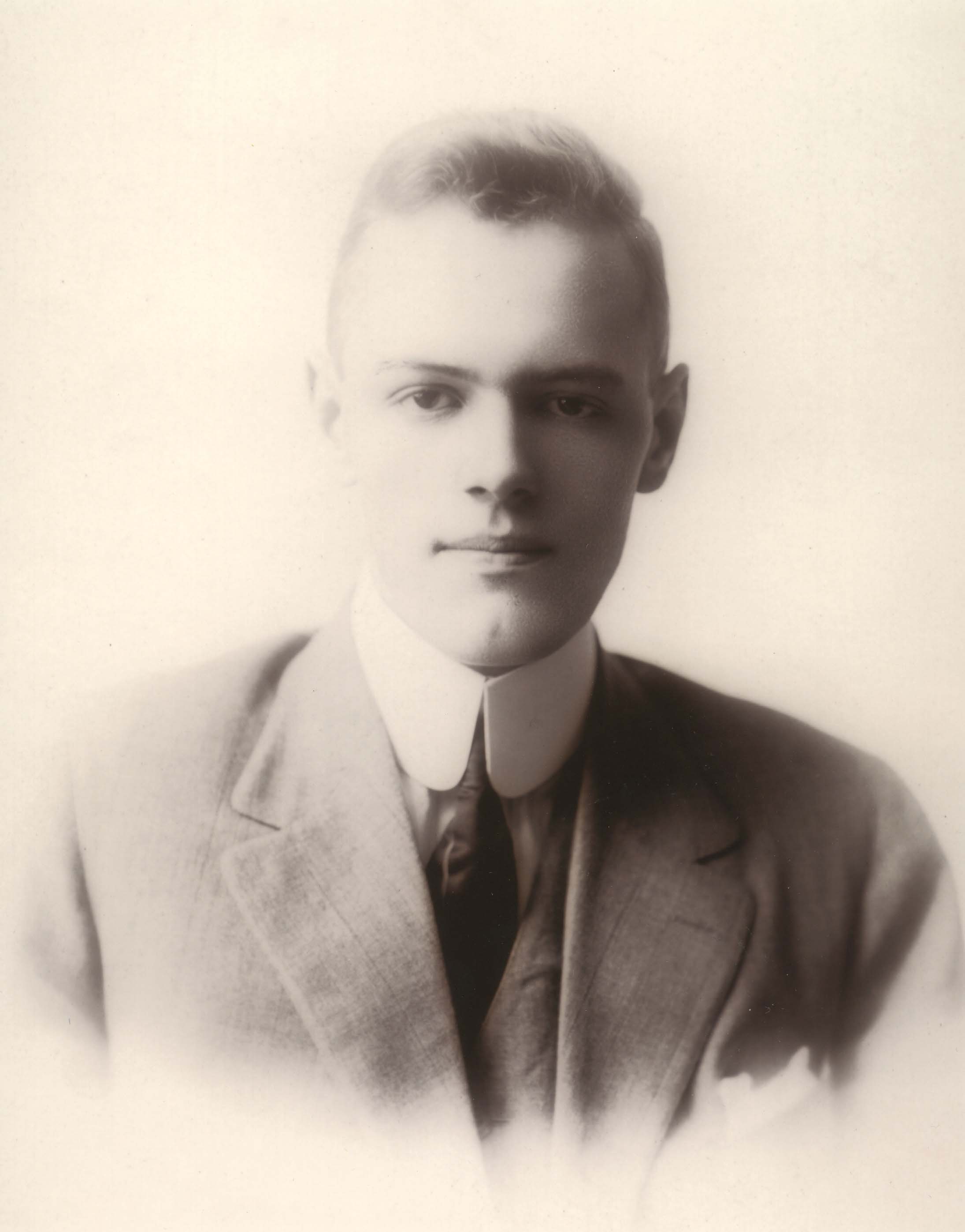
Robert Wood Johnson, Approx. 16 Years Old

General Robert Wood Johnson was particularly close to the Company’s employees of Hungarian heritage, often accepting invitations to their homes, to weddings and other celebrations. This relationship started when Johnson was just a teenager and came to work in the factory during the summers and then full time after his father died. He was befriended by his Hungarian coworkers as they worked side by side, and the relationship continued through his adult life.

To this day, the Company continues to have a number of New Jersey employees and retirees of Hungarian descent….a relationship that still continues a century later.

Update – I forgot to mention that the title of this post, “Hungarian University,” was a nickname given to Johnson & Johnson because of its large percentage of Hungarian employees. The Company’s generous benefits and steady employment at a time when that was uncommon offered great opportunity for members of the Hungarian community who worked there.

This post was written by Margaret

Published in: People, Did You Know?, Employees, New Brunswick | on June 19th, 2008 | 1 Comment »

100 Years Ago: Celebrating a New Addition to the Cotton Mill

 1908 Cotton Mill Reception Employees

In 1908 Johnson & Johnson completed an addition to the “New” Red Cross Cotton Mill.  The mill had been built in 1901 and just a few short years later, it needed to be expanded due to the growth of the surgical dressings, cotton and gauze business and the need for extra manufacturing capacity.   As was its tradition, the Company held a reception and dance for employees to inaugurate the new building…on the evening of Friday, October 2, 1908 from 8:00 pm to midnight. 

Let’s step back to that evening 100 years ago and take a look.

New Brunswick Times Article, 1907   1908 Cotton Mill Reception Employees

According to Oct. 3, 1908 edition of The New Brunswick Times, the party was “one of the largest and jolliest dances ever held in New Brunswick,” and The Home News estimated that over 2,500 people attended.   The Times went on to mention: “It has been the custom of this firm to have an affair something in the nature of a housewarming in every large addition built to the plant before the machinery is installed.”  (N.B. Times article, “Two Thousand at J. And J. Dance,” Oct. 3, 1908) This was the Company’s way of celebrating its success with employees, and it had a special significance in 1908.  The U.S. had been hit by the Panic of 1907, a financial crisis and recession, but Johnson & Johnson had managed to weather the storm and even continue expanding its plant capacity due to the nature of its products and the prudence of its management.

Cotton Mill and Edition, 1907

The Cotton Mill and New Addition, 1907.  The dirt road is George Street.

So on that Saturday night in October of 1908, employees and their guests arrived at the addition to the Cotton Mill, which was located exactly where Johnson Hall stands today.  The new addition brought the Company’s campus to 40 buildings and a half million square feet of manufacturing space.  There was such a large crowd in the Cotton Mill that the dance took place on two floors of the huge addition, with Haywood’s Orchestra providing the music on one floor, and Professor Chas. Mezei’s Hungarian Orchestra playing traditional Hungarian music on the other floor for the enjoyment of the Company’s numerous Hungarian employees. Each attendee received a card marked “Refreshments,” which was redeemed for a brick of Neapolitan ice cream and cake. Robert Wood Johnson and James Wood Johnson attended along with their families, and employees received a dance order booklet and a small commemorative spoon as souvenirs.  (A dance order booklet provided space in which to write the names of everyone you danced with.)

1908 Cotton Mill Reception Souvenir Program

Souvenir Booklet from 1907 Reception


1907 Order of Dancing

Inside Back Cover of Booklet, Showing Order of Dance Listing

In keeping with the character of the Company, the booklet didn’t just contain space for social information.  It also had a letter to employees from President Robert Wood Johnson, a listing of the Company’s entire executive and supervisory staff (a number of the department supervisors were women, and there was a female scientist in the Scientific Department!), an article on the Company’s history up to 1908, and articles on the Laurel Club and the Company’s Welfare Department (the department that provided medical care and other benefits to employees).  Here are some excerpts from Robert Wood Johnson’s letter: 

Robert Wood Johnson the first

Robert Wood Johnson 

“We are all fortunate, in that we are engaged in manufacturing products to be used throughout the world for the relief of pain and suffering.  We believe that each and every one of us is entitled to some credit and a certain reward for being factors in benefitting [sic] mankind.  Johnson & Johnson have been educators, teaching the world how to treat wounds according to modern methods and how to save life….Johnson & Johnson do not forget that a great part of their success has been due to the skill and care taken by their employees, you all put forth your best effort loyally and jointly, observing all the rules relating to modern wound dressing so that when the products reach the surgeon or the physician he has felt absolute confidence in them.” 
“You are carrying out every day rules of cleanliness which have always been our watch-word, and we feel proud of having a force who know and realize the necessity of such supreme care, and who realize that the use of the goods which they prepare may mean life or death to those whom they may be applied.” 
“We, therefore take this opportunity of thanking you and to express our appreciation of the good work which you have done not only for Johnson & Johnson but for the world at large.”

The letter shows the camaraderie that Johnson felt for his ever-growing number of employees, and the knowledge that they were all engaged together in an important mission to help people.  Echoes of Johnson’s words from 100 years ago can be seen today in the way we refer to the Johnson & Johnson Family of Companies, as well as in our new Company description: 

Caring for the world, one person at a time… inspires and unites the people of Johnson & Johnson. We embrace research and science - bringing innovative ideas, products and services to advance the health and well-being of people. Employees of the Johnson & Johnson Family of Companies work with partners in health care to touch the lives of over a billion people every day, throughout the world.

This post was written by Margaret

Published in: People, Advertising, Employees, New Brunswick, Milestones, Events, Anniversaries | on June 5th, 2008 | No Comments »

Does This Man’s Handwriting Look Familiar to You?

 James Wood Johnson

James Wood Johnson

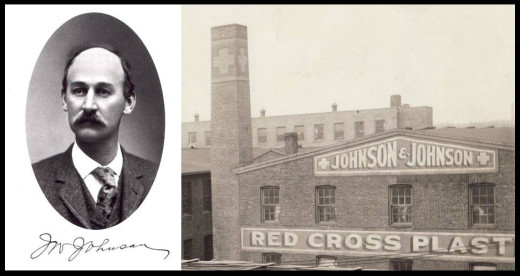
Most people, unless they read this blog, have probably never heard of James Wood Johnson, one of the three brothers who founded Johnson & Johnson in 1886.  But more than a billion people around the world are familiar with his handwriting.  Why?  Because the Johnson & Johnson logo is based on it.

James Wood Johnson's signature

James Wood Johnson’s signature

Early Example of Johnson & Johnson Logo

Johnson & Johnson logo circa 1920s

This familiar logo has been a part of Johnson & Johnson since the beginning.  It’s not a typeface, but is based on handwriting…one particular person’s handwriting.  You can see the similarities between the shape of the “J,” the loop on the “h” and in the “s” in James’s handwriting and in the logo.  You’ll also notice above that James Wood Johnson connected the “W” in his middle initial to the “J” in Johnson.  When James wrote the name Johnson & Johnson, he did the same thing: he connected the ampersand to the second “J.” 

Company name written by James Wood Johnson on a check in 1886.  Note the connection of the ampersand and the second “J”


 Absorbent Cotton Label

As I mentioned in a previous post, James Wood Johnson and his brother Edward Mead Johnson are the Johnsons in “Johnson & Johnson.”  Their older brother Robert joined the Company several months later, once he was free of his obligations to his previous business, Seabury & Johnson.   (It’s a measure of the founders’ foresight that they didn’t change the Company name to “Johnson & Johnson & Johnson” when this happened.)

Early Cotton Product circa 1887

One of the Company’s earliest products.  The logo looks even more like a signature here.

The new company wanted a visual identity that would set it apart from its competitors in the medical products field.  The Johnsons’ new business was indeed different – it sold the first commercial mass-produced sterile surgical dressings, as well as sterile sutures, and it improved the manufacturing and the efficacy of the popular medicated plasters it sold.  So the Johnson brothers wanted a distinctive way to represent their new business’s name.

If anyone has ever wondered about how companies come up with their logos (okay, maybe ONE person out there has ever wondered about that), it’s probably assumed that they hire design firms who submit designs that are tested and re-tested and then one is chosen…which is how you would come up with a logo today.  But we’ve had the same logo for well over a century.  So what did companies do in the 1800s?

In the 1800s, most companies just set their names in type…like the Lambert Pharmacal Company, which was formed to manufacture LISTERINE® Antiseptic.  Or Seabury & Johnson.  Or P&G.

 listerine-1924-bottle3.jpg

A few companies, like the Coca-Cola Company (also founded in 1886) had distinctive logos that gave people immediate visual recognition and a set of expectations, based on their products.  (In modern times, we would call that branding.)  From its earliest days, Johnson & Johnson used what we call our corporate signature as the distinctive way of representing the Company. 

Here’s the logo on some of our earliest products:     

  Early Sutures    Early Cotton and Gauze Products

It’s not only the Johnson & Johnson logo that’s based on James Wood Johnson’s handwriting, but also the JOHNSON’S® brand name logo too.  Here’s an example…in which it’s easy to see how both logos evolved from James Wood Johnson’s signature.

Baby Cream, 1920s

JOHNSON’S® Baby Cream, 1920s 

Interestingly enough, the signatures of Robert Wood Johnson the first and his brother James Wood Johnson are kind of similar, especially in the way they signed their last name.  So although the logo is based on James’ signature, it also looks like Robert’s too.

James Wood Johnson's signature 

 Robert Wood Johnson's signature

 The signatures of James Wood Johnson (top) and Robert Wood Johnson (bottom) 

The fact that Johnson & Johnson based the look of its name on one of the founder’s handwriting shows how personally the Johnson brothers were connected to their company, their products and their mission of improving health care for people…personally enough for one of them to put his signature on it.

This post was written by Margaret

Published in: Beginnings, Trivia, Did You Know? | on May 20th, 2008 | 2 Comments »

Congratulations, Robert Wood Johnson!

General Robert Wood Johnson

What do General Robert Wood Johnson, Frank Sinatra, Albert Einstein, Bruce Springsteen and Toni Morrison all have in common?  They are among the first group of inductees into the New Jersey Hall of Fame.

Yesterday (May 4th) General Robert Wood Johnson was among the first group of New Jersey citizens inducted into the New Jersey Hall of Fame, sharing the occasion with other notable New Jerseyans Harriet Tubman, Thomas Alva Edison, Albert Einstein, Clara Barton, Frank Sinatra, Buzz Aldrin, Yogi Berra, Malcolm Forbes, Vince Lombardi, General Norman Schwarzkopf, Toni Morrison, Bruce Springsteen, Meryl Streep and Bill Bradley.

General Johnson was recognized for visionary leadership and for building Johnson & Johnson into the global company it is today, as well as for his philanthropy.  The General’s grandson Robert Wood (Woody) Johnson accepted the award.

General Robert Wood Johnson (1893 — 1968) was the son of Company founder Robert Wood Johnson, and was born and grew up in New Brunswick.  He spent his formative years around Johnson & Johnson, often accompanying his father to business meetings and events and, when he was old enough, he worked summers at his family’s company just a few blocks away from his house.   The death of his father in 1910 accelerated his plans to join his family’s business, and he did so instead of attending college after he graduated from Rutgers Prep.   

Portrait of Robert Wood Johnson

Robert Wood Johnson had a long tradition of public service and philanthropy, which was influenced by the lessons he learned as a child from his father, one of the three brothers who founded Johnson & Johnson.  Some of Robert Wood Johnson’s notable accomplishments:

He served as Mayor of Highland Park when he was 26. 

He wrote Our Credo in 1943, which 65 years later, continues to guide the Company and outline the responsibilities of Johnson & Johnson to, in the following order, doctors, nurses, patients and all those who use our products and services; employees; the communities in which we live and work; and last, our shareowners.  (When Robert Wood Johnson wrote that, he was the largest shareowner, and he put himself last.)  Johnson felt that, if we do the first three things correctly, then the last item would take care of itself.

He was the architect of the Company’s policy of decentralization and of our global growth and expansion from a small family-owned business into a worldwide family of companies. 

Starting with donating its first typewriter in 1918, Johnson supported Middlesex Hospital (Now known as Robert Wood Johnson University Hospital) and St. Peter’s University Hospital, and contributed to the education and training of nurses and the field of hospital management countrywide.  It was Johnson’s idea that hospitals should be organized by medical specialty, something that was rare when he suggested it and is common practice today.

 Robert Wood Johnson and Employees

Robert Wood Johnson (lower center) and Employees

Johnson was a thinker and writer about business, and was the author of a number of widely read books and articles.  Many of his ideas went squarely across the grain, such as his thoughts about the ethical responsibilities of business, or his repeated calls during the Great Depression for higher wages for workers.  In the 1930s, in a pamphlet called “Try Reality,” he wrote:  “…industry only has the right to succeed where it performs a real economic service and is a true social asset.” 

General Johnson in Uniform

General Robert Wood Johnson in Uniform, 1940s

Johnson was named by President Franklin D. Roosevelt to head the Smaller War Plants Corporation in Washington during World War II, and was appointed to the rank of Brigadier General.  He served for only about two months before he left, frustrated with the bureaucracy, but the title stuck with him. 

General Robert Wood Johnson left the bulk of his fortune to the Robert Wood Johnson Foundation.  

Johnson embraced his reputation as a maverick, as illustrated by one of his favorite sayings: “Why be difficult when with a little more effort you can be impossible.” 

[Saying quoted from “General Johnson Said…,” by Philip B. Hofmann, 1971, Leury, Marks & Strasser, Inc., North Brunswick, NJ, p. 54]


This post was written by Margaret

Published in: People, Did You Know?, Local Interest, Milestones, Events | on May 5th, 2008 | No Comments »

10 Things You Didn’t Know About J&J

 Office Interior, 1940s

A Peek Inside One of Our Offices in the Mid-1940s


1. The Company started on the fourth floor of an old wallpaper factory.

2. In the Nineteen-teens, before air conditioning, Johnson & Johnson had a swimming pool for employees – at work! — so they could cool off in the summer heat.

3. When he was younger, Robert Wood Johnson the first was known to wear a stovepipe hat.  (We don’t have a picture of him wearing the hat in our archives, unfortunately.)

4. Barry Manilow wrote the “I Am Stuck on BAND-AID® Brand…” jingle.

5. John Travolta, Terri Garr and Brooke Shields all appeared in BAND-AID® Brand Adhesive Bandage commercials before they became famous.

6. During World War II, Hollywood movie star Hedy Lamarr came to Johnson & Johnson in New Brunswick for a war bonds rally.  She wasn’t just a pretty face; she invented a technology that made modern wireless communication possible.

7. We used to make duct tape.  Permacel, the company that invented duct tape, was a part of the Johnson & Johnson Family of Companies until 1982.

8. One of our most recently acquired consumer products, the BENGAY® Pain Relieving Patch, does the same thing that medicated plasters did in 1887 – it delivers pain relief directly through the skin. 

9. One of the founders of Johnson & Johnson (Robert Wood Johnson), the founder of DePuy, Inc., and one of the founders of our McNeil franchise all started out working as clerks in retail pharmacies.

10. We used to own a company that made sausage casings, which evolved from research into the possibility of developing collagen as an absorbable suture product.  Collagen never panned out as suture material, but Devro, the company that resulted from that research, is still going strong.  It was part of the Johnson & Johnson Family of Companies until 1991, when its management bought it out and spun it off. 

11. Okay, 11 things.  Here’s one more as a bonus.  We made a tooth-whitening tooth cream in 1887.

This post was written by Margaret

Published in: People, Trivia, Unusual Products, Did You Know?, New Brunswick | on April 30th, 2008 | 2 Comments »

Revra DePuy and the Orthopaedics Business

 Revra DePuy

Revra DePuy 

Did you know that oldest orthopaedics company in the world started in a small room in an Indiana hotel?  That company is DePuy, Inc. (part of the Johnson & Johnson Family of Companies since 1998) and it’s named after its founder, a man named Revra DePuy.   Revra DePuy was born in 1860 in Grand Rapids, Michigan.  His family moved to Canada shortly after his birth and later returned to the U.S. when his father died, settling in Illinois.  According to the DePuy family thread on Rootsweb, the family saw some hard times during this period.  Revra DePuy worked as a clerk in a drug store (as did Robert Wood Johnson the first) and the work interested him enough to cause him to take a course in chemistry at the University of Toronto in Canada, where he got his degree.  After graduation, DePuy got a job as a traveling salesman. 

According to the Warsaw Daily Times of October 10, 1921, referenced here, Revra DePuy was also a chemist during his early career, and is credited with inventing the formula for sugar coating pills. 

In the late 1800s, splints for broken limbs were distinctly unscientific, and were made out of barrel staves or other similar makeshift materials.  DePuy saw that there was a huge need for something better to help heal broken limbs, and he got the idea to start a business to produce specifically-designed splints that could be customized to fit patients, rather than the improvised splints that were commonly used.  DePuy decided to open his business in Warsaw, Indiana (where its headquarters remains today) after visiting the town as part of his job as a traveling salesman. 

Hotel Hays, Courtesy of the City of Warsaw, IN

The Hotel Hays, Headquarters of Revra DePuy’s New Company from 1895-1901

Here’s the link to the above photo, which is also reproduced here, courtesy of the City of Warsaw, IN and warsawcity.net.

Revra DePuy settled in, married the daughter of the local sheriff, and started building his new business.  The first DePuy plant was at the corner of Columbia and Center streets in Warsaw, and the company made specially constructed splints using fiber and wire.  Revra DePuy’s company, then called DePuy Manufacturing, was the first commercial orthopaedics manufacturer in the world.  [Update:  DePuy Manufacturing, later DePuy, Inc., was founded in 1895.]

Interestingly enough, in 1905 DePuy hired a man named Justin Zimmer as his first sales representative.  Six years after Revra DePuy died, in 1927, Zimmer left the company now run by DePuy’s widow to start his own orthopaedics company.

Revra DePuy died in 1921.  The business he started revolutionized the way orthopaedic injuries and conditions were treated.  Not only did DePuy, Inc. manufacture the first state-of-the-art splints in the 19th century, the company almost 100 years later pioneered the first hip and knee joint replacement implants.  

A thread on Rootsweb quotes an unattributed obituary for Revra DePuy, which gives a small sense of what DePuy was like as a person: 

“Revra Depuy, who has manufactured wire splints for 25 years, was one of Warsaw’s substantial businessmen and his advice was frequently sought in a business way. He was a well-educated, self-made man and had a knowledge of nearly every subject far beyond the average.  He was generous and courteous and had many warm personal friends among those who knew him well.”

Here’s another interesting bit of information about DePuy, Inc.:  in the 1950s, long before female chief executives were common, DePuy had a female president, Mrs. Amrette Hoopes.  Here’s an article about her, with pictures.

This post was written by Margaret

Published in: People, Beginnings, Did You Know?, Local Interest | on April 24th, 2008 | No Comments »

Camp Baby: Business Is People

My colleagues Marc and Lori recently posted about Camp Baby, a recent event in which the Company invited over 50 women who are mom bloggers to New Brunswick.  The purpose of the event was for them to get to know Johnson & Johnson a little bit better, and for us folks at Johnson & Johnson to get to know the bloggers a little bit better.  One of the most interesting things about Camp Baby from the perspective of this blog is that it’s the kind of direct conversation with the public that Johnson & Johnson used to have around 100 years ago. 

Here’s an example of Johnson & Johnson doing just that in 1916…bringing a retail druggist who sold our products in for a visit.  And the druggist wrote about his experiences in a publication geared to other retail druggists.

Our former chairman General Robert Wood Johnson (1893 – 1968), who grew up watching his father, his uncle and Scientific Director Fred Kilmer communicate directly with the community, was a believer in keeping up a direct dialogue.  In the 1940s, he gave a series of talks about various aspects of business to Company employees, which were later compiled into a book called Robert Johnson Talks It Over.  He mentioned the various things the Company was doing in the 1940s to talk to people, such as sending speakers to community organizations, inviting groups of people to Johnson & Johnson (like we did with Camp Baby), giving students and others the chance to see what it would be like to work at Johnson & Johnson, publishing articles about the Company, and encouraging employees to talk to their friends and neighbors and answer any questions they might have.  Here’s what he said about businesses and people:

“Business Is People.” 

He went on to explain: 

“Suppose you had to answer the question, What is Business?  Would you say it is buildings, machinery, or goods to be bought and sold?  Would you call it equipment that performs service…?…A corporation is just a name and a legal formula on a piece of paper.  It is useful and even important, but it doesn’t get ideas for machines.  People have to do that, and they also must turn those ideas into equipment which still other people will use.”  [Robert Johnson Talks It Over, Johnson & Johnson, New Brunswick, NJ, 1949, p. 10]

“For the present, our interest lies in the fact that our companies operate because men and women – people – do their jobs and do them together, using materials and equipment provided by other men and women.  As a team, they turn mere things into going concerns.  That’s still another way of saying that our business – all business – is people…”  [Robert Johnson Talks it Over, p. 13]

Throughout its history, Johnson & Johnson (or, I should say, the people at Johnson & Johnson) liked to hear from the patients and customers who used our products.  In fact, that’s how we got into the baby products business and how we made the first-ever First Aid kits in the first place. 

Robert Wood Johnson felt that as citizens of their communities, businesses should have the understanding of their fellow citizens, and vice versa.  He wrote:  “Good community relations for business are just good neighborly relations on a large scale.”  [Robert Johnson Talks It Over, p. 80.]   At Camp Baby, we got to know some of our neighbors a little bit better.

This post was written by Margaret

Published in: People, Milestones | on April 8th, 2008 | 3 Comments »

Beauty Spots

Throughout its history, Johnson & Johnson has been known for developing and making products in response to needs in society…such as the first commercially available sterile surgical dressings.  Occasionally, though, the Company produced a product that helped fill a more unusual need in society.  One early product filled not a health care need, but a fashion craze.  And that product was…Beauty Spots.    

Beauty Spots Package Showing Beauty Spots in Use

Beauty Spots were small pieces of material – usually black silk or sometimes velvet – with adhesive on the back.  They were most commonly shaped like small stars, crescents, arrows, hearts or circles.  Beauty Spots were used by women to attract attention to the complexion or an outstanding facial feature, such as the eyes, mouth, or a dimple.  They would stick the product on their faces near whatever facial feature they wanted to accentuate.  Occasionally, according to sources, women would use a number of them at once, which gave them the unfortunate appearance of having broken out in oddly shaped spots. 

Beauty Spots from 1913

In 1915, the Company wrote:

“To supply the demand created by this fashion we have arranged an assortment of designs consisting of stars, crescents, arrow points, hearts, etc., which are put up in envelopes, each containing 100 spots (3 dozen on a card); also in fancy boxes containing 300 assorted.”  [RED CROSS MESSENGER p. 286, March 1915, Vol. VII, No. 10.]

It was typical of Johnson & Johnson that, rather than just putting the product on the market (where it was bought by fashion-conscious women), the people at the Company felt the need to provide some education and background about its Beauty Spots.  So Fred Kilmer wrote about them in the March, 1915 issue of THE RED CROSS MESSENGER, the Johnson & Johnson publication for the retail druggists who sold our products.

According to Fred Kilmer, Beauty Spots were worn in Ancient Rome and Egypt, and there was a beauty spot fad in 17th century France during the reign of Louis XIII, and in England during the reign of Queen Anne.  Kilmer included an illustration from an old treatise on Beauty Spots (shown below) that shows someone wearing a number of them at once, including an elaborate horse-drawn carriage running entirely across her forehead!

 rcmbeautyspotpic.jpg

RED CROSS MESSENGER Reproduction of Old Illustration Showing Beauty Spots in Use

Johnson & Johnson made Beauty Spots out of materials left over from making plasters.  Since 1887, Johnson & Johnson had been making Court Plasters, which had the same origins but were the more practical cousin to Beauty Spots.  To confuse matters, Beauty Spots were sometimes referred to as Court Plasters, a name that goes back to their origins in the royal courts of Europe.  They had been used by court women, who set the fashions in their day.  According to Fred Kilmer, Court Plasters started out as fashion statements, before being used by the masses to cover small cuts and scratches. 

Black Taffeta Court Plasters 

 Colorful Packaging for Arnica Court Plaster

Court Plasters were small and adhesive, and came in little pocket-sized sheets that could be cut to size to cover up a small scrape or cut.  They were made of luxurious materials like silk and taffeta, and came in a variety of colors.  (A tradition that was later continued by BAND-AID® Brand Adhesive Bandages!) 

 img_wound_bandaid_03_pic.jpg

Continuing the Court Plaster Tradition?

Johnson & Johnson also made Court Plasters from isinglass, a material derived from fish scales.

 Cotolia Liquid Court Plasters Ad     Cotolia Liquid Court Plasters

Cotolia Liquid Court Plaster

Oddly enough, the Company also made a liquid Court Plaster to put over small wounds, which sounds a lot like this modern product.  (You will need to scroll down to the second product on the page.)

Fred Kilmer attributed the revival of Beauty Spots to the revival of little “vanity boxes” that could be carried in a purse.  They contained a mirror and could hold small items, such as a sheet of Beauty Spots. 

beautyspots3.jpg

Beauty Spots Packaging, Product and Vanity Boxes

The Company provided educational background not just on its lifesaving products, but on its more unusual products as well, and Beauty Spots were no exception.  Why?  So that the druggists selling the products would understand them and be knowledgeable enough to answer the public’s questions. 


This post was written by Margaret

Published in: Beginnings, Early Products, Trivia, Unusual Products, Did You Know? | on March 25th, 2008 | No Comments »